

Complexity Is the Enemy of Reliability: Lessons From Connected Products
Reliability does not collapse in one dramatic event. It erodes when every layer ships independently without a shared system model. This field note explores how connected products accumulate hidden risk and what disciplined engineering guidance does differently.
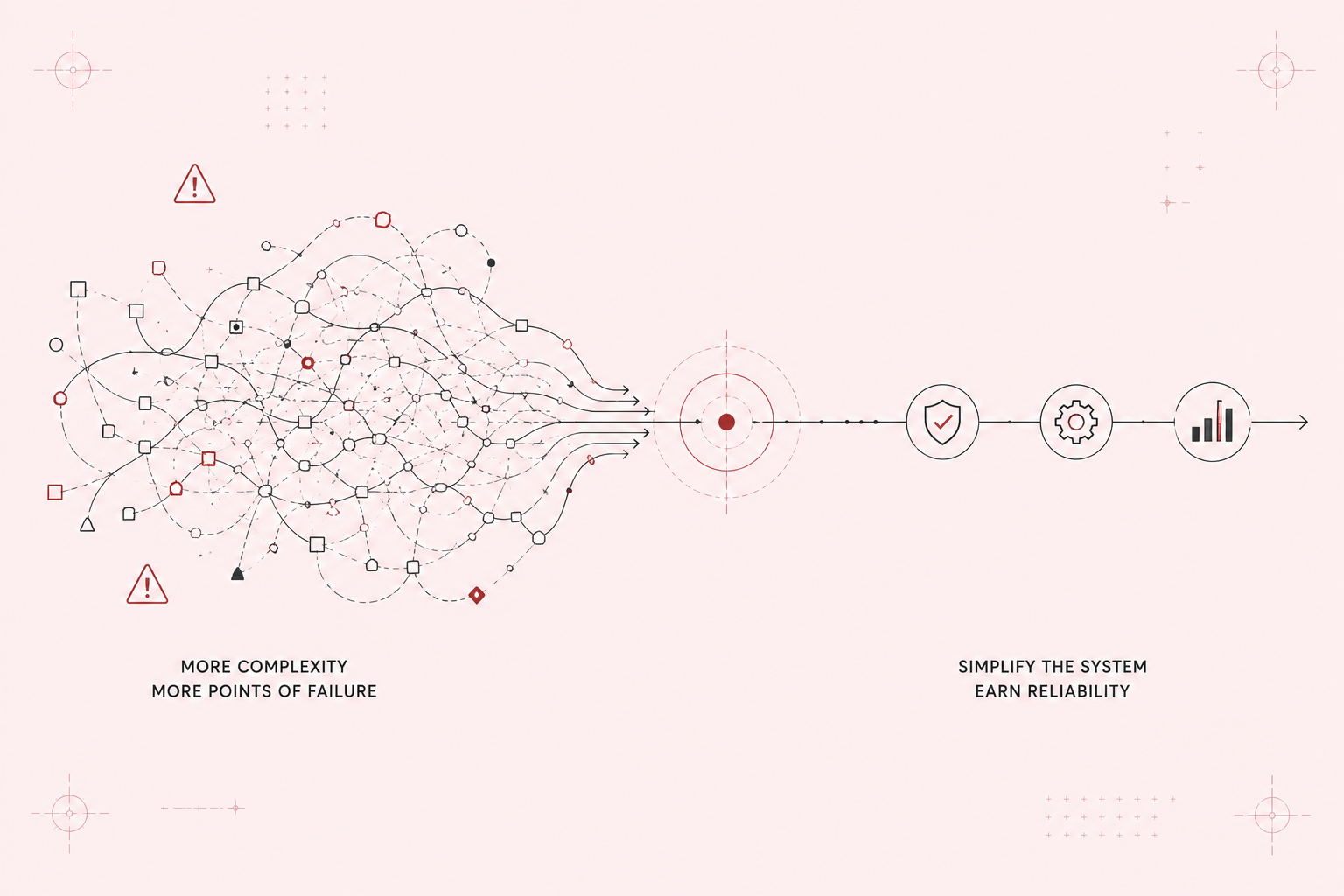
Reliability rarely dies in a single release. It erodes quietly when every layer ships on its own schedule, each team confident in local success while the system drifts out of alignment.
Why This Matters
Product ambition is increasing faster than integration discipline. Feature velocity across edge, cloud, and application layers creates hidden coupling that is rarely visible in sprint planning.
Feature velocity across edge, cloud, and application layers creates coupling that sprint boards never surface.
The Problem Today
Complexity is usually managed as project management overhead rather than engineering architecture. Teams track tasks, but they do not track dependency risks with equal rigor.
Complexity managed as task volume hides dependency risk until integration — when changes are expensive and schedules are fixed.
Where Systems Break
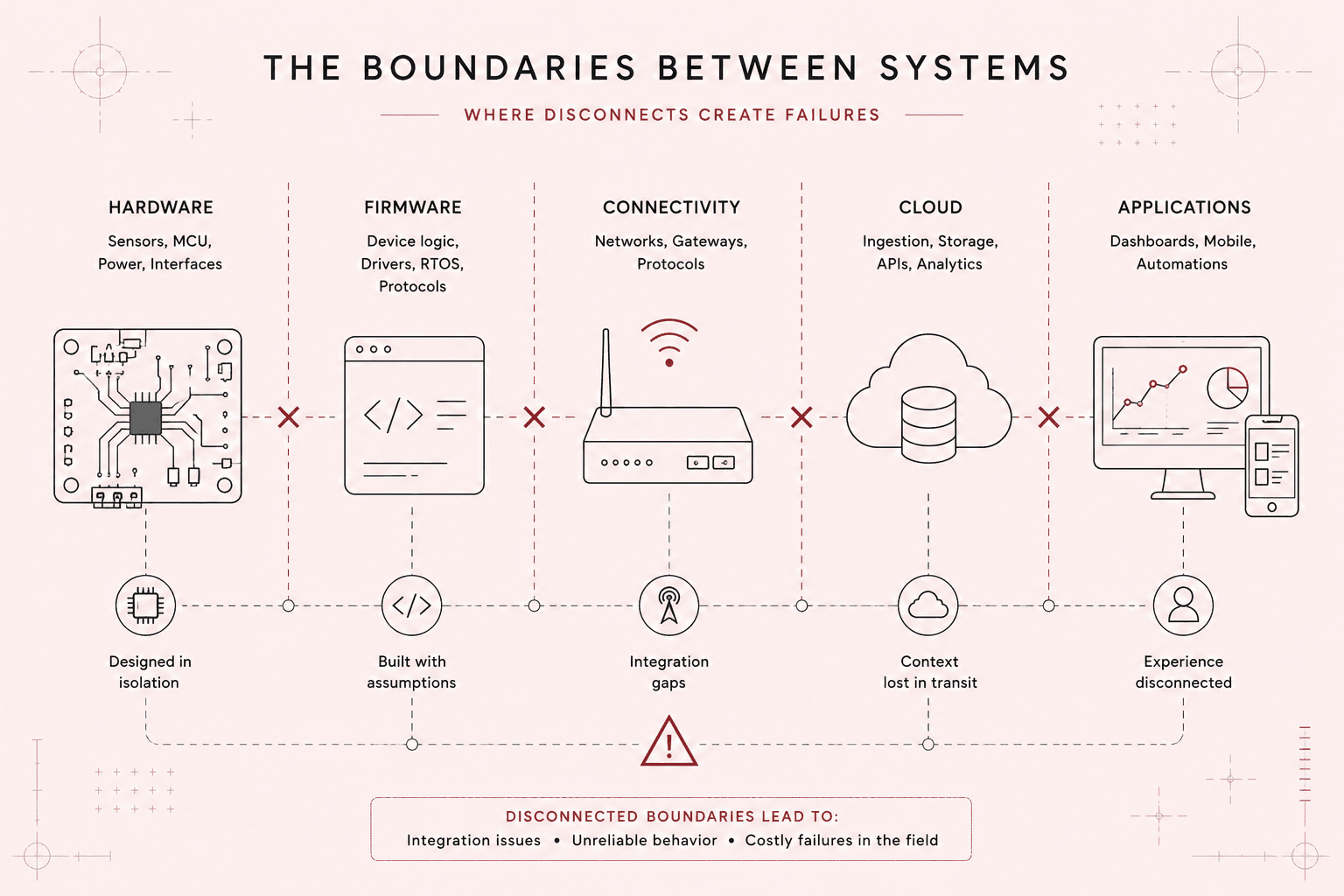
Each release introduces new interactions: firmware timing affects cloud batching, cloud schema changes alter app behavior, and infrastructure policies influence field device performance. These interactions compound silently.
Each independent release changes assumptions downstream. The system becomes a moving target nobody can fully reason about.
What Happens in the Field
The result is predictable: delayed launches, unstable updates, brittle recoveries, and repeated regression loops. Failures are treated as isolated bugs even when they originate from systemic architecture drift.
Delayed launches, unstable updates, and regression loops are treated as execution problems when they are often architecture drift problems.
How Experienced Teams Think
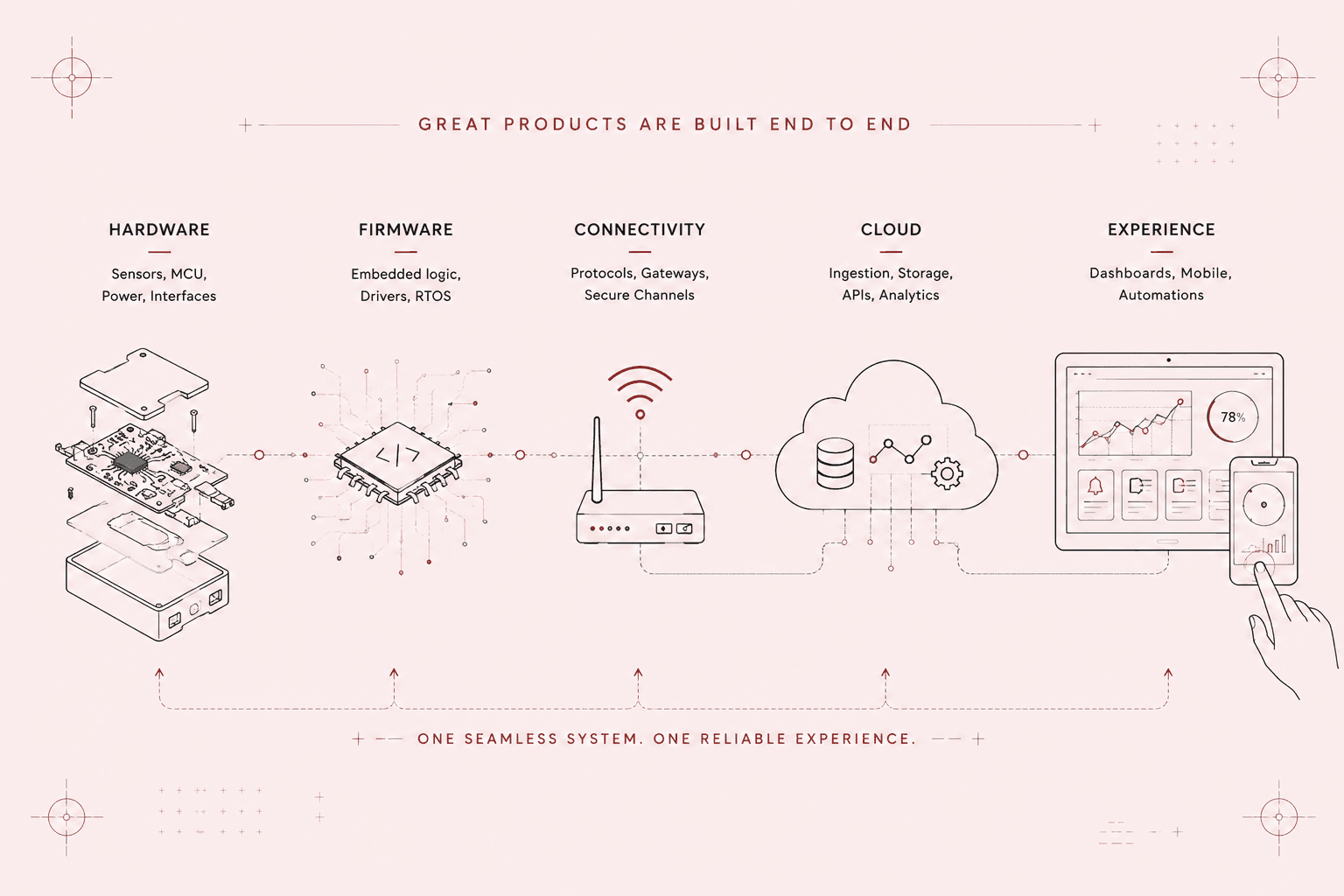
Reliability improves when complexity is modeled as a system property. Teams that maintain a shared architecture baseline and enforce cross-layer change impact reviews reduce integration surprises dramatically.
Reliability returns when teams model complexity as a system property with one shared baseline and enforced cross-layer change review.
Key Learnings
- Complexity is not removed by adding vendors — it is resolved through guided convergence.
- Delayed releases often signal integration debt, not feature scope.
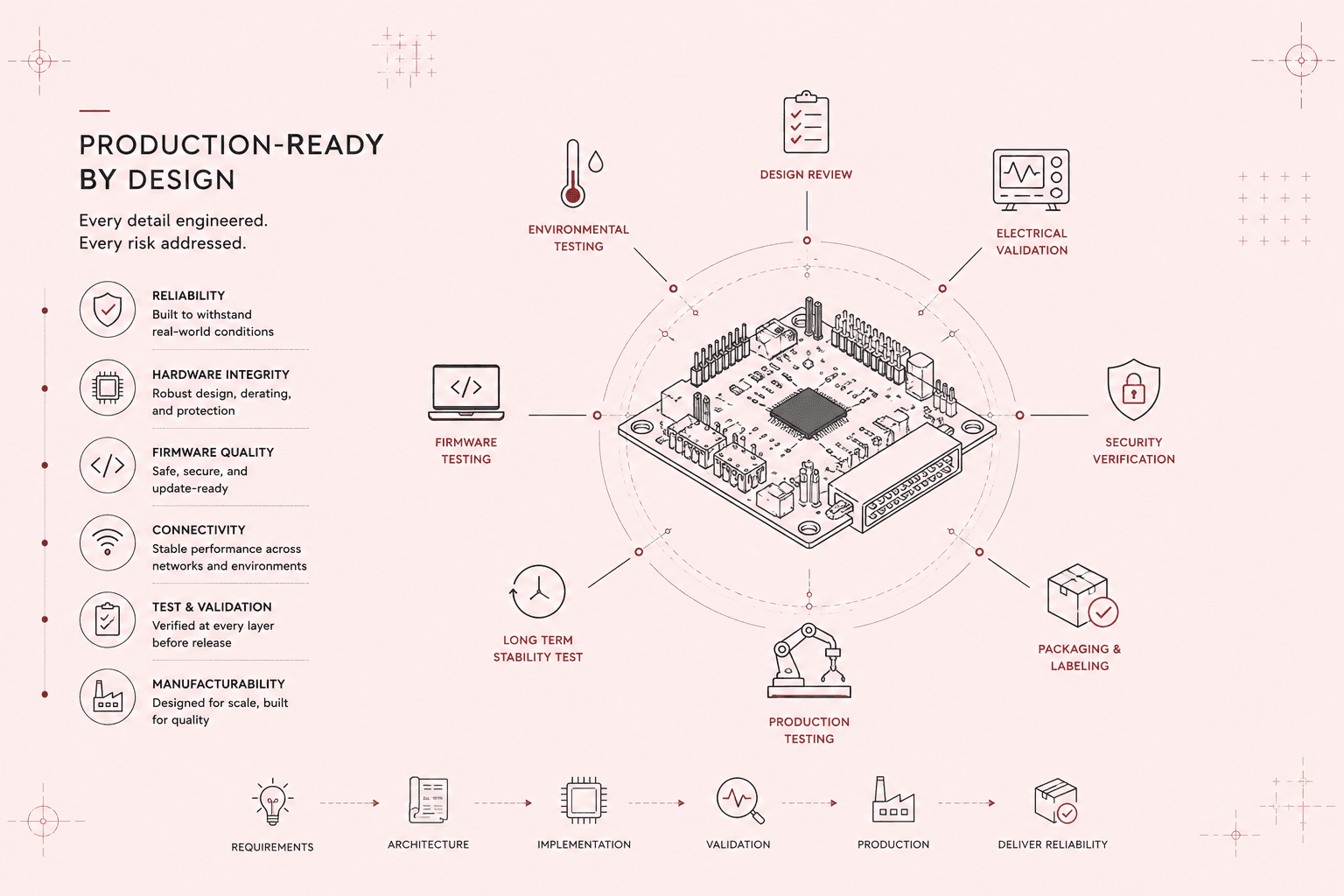
- Field-ready systems require validation at every layer transition.
Turning Complexity Into a Managed System Property
Dartwings treats complexity as an architecture outcome, not a backlog symptom. We establish one shared system model and enforce cross-layer impact review before changes propagate into firmware, cloud, or client behavior.
Programs we guide converge on fewer unowned interfaces, shorter integration cycles, and validation evidence that proves the full path — not isolated components — can hold under production stress.
From Challenge to Precision Outcome
Dartwings is an Engineering Guidance Partner — not a software agency or IoT vendor. We guide disconnected technologies through architecture, execution, validation, and deployment until they become reliable, field-ready systems.
- SCOPEChallenge
- MAPArchitecture
- BUILDEngineering
- HARDENValidation
- LAUNCHDeployment
- LOCKPrecision Outcome
Continue Reading
Start Your Mission
Whether you have a defined technical spec or the seed of an idea, describe your engineering challenge and we will respond with a guided path to a validated outcome.