

Why Modern IoT Products Fail at the Boundaries Between Systems
Complexity rarely breaks products in obvious ways. It compounds quietly at the boundaries between hardware, firmware, cloud, and user experience until reliability starts to drift. This insight explains why system seams fail in production and how cross-layer architecture restores control.
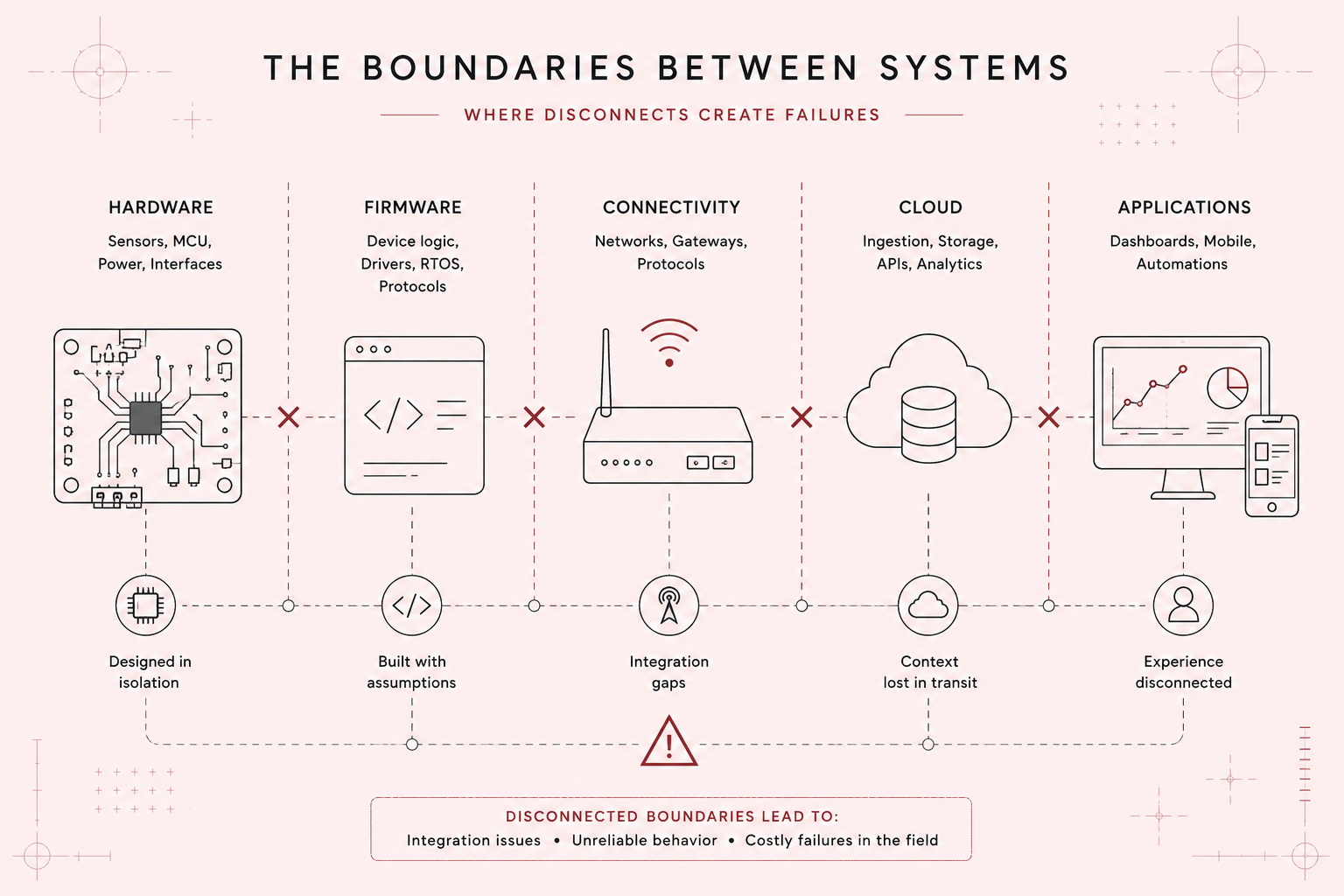
Most connected products do not fail because a single component was poorly built. They fail because no one owned the seam where components meet — and that seam is where field reliability is won or lost.
Why This Matters
Connected products now combine embedded firmware, radio behavior, cloud orchestration, and user-facing controls. The product is no longer a device; it is a distributed system with strict timing, data, and state dependencies.
The shift from standalone devices to connected systems changed the failure model — but many engineering organizations still plan, build, and test as if layers were independent.
The Problem Today
Teams often split responsibilities by discipline, but nobody is explicitly accountable for the seams between disciplines. As a result, assumptions are copied across interfaces rather than engineered and validated as contracts.
Without explicit boundary ownership, teams inherit assumptions from upstream layers they never validated — and those assumptions become production defects.
Where Systems Break
Most failures emerge at handoff points: reconnect windows, schema transitions, queue semantics, provisioning workflows, and retry behavior during degraded networks. Each layer looks correct in isolation while the full system drifts out of alignment.
Boundary failures rarely appear in unit tests. They surface when timing, state, and retry semantics collide under real network and power conditions.
What Happens in the Field
In production this appears as intermittent failures that evade bench testing: devices that never recover after reconnect, stale app states, partial telemetry, and support tickets that cross multiple vendors without a single owner.
Support teams chase symptoms across vendors while the root cause sits in an interface contract nobody documented or tested under load.
How Experienced Teams Think
Experienced teams treat boundaries as first-class architecture work. They define explicit ownership for state transitions, failure behavior, and compatibility rules before implementation, then validate those rules under realistic constraints.
The fix is not more integration meetings — it is boundary architecture with assigned ownership and validation gates before scale.
Key Learnings
- Most field failures trace to interface contracts that were never validated under load.
- Boundary ownership must be assigned before build — not discovered during integration.
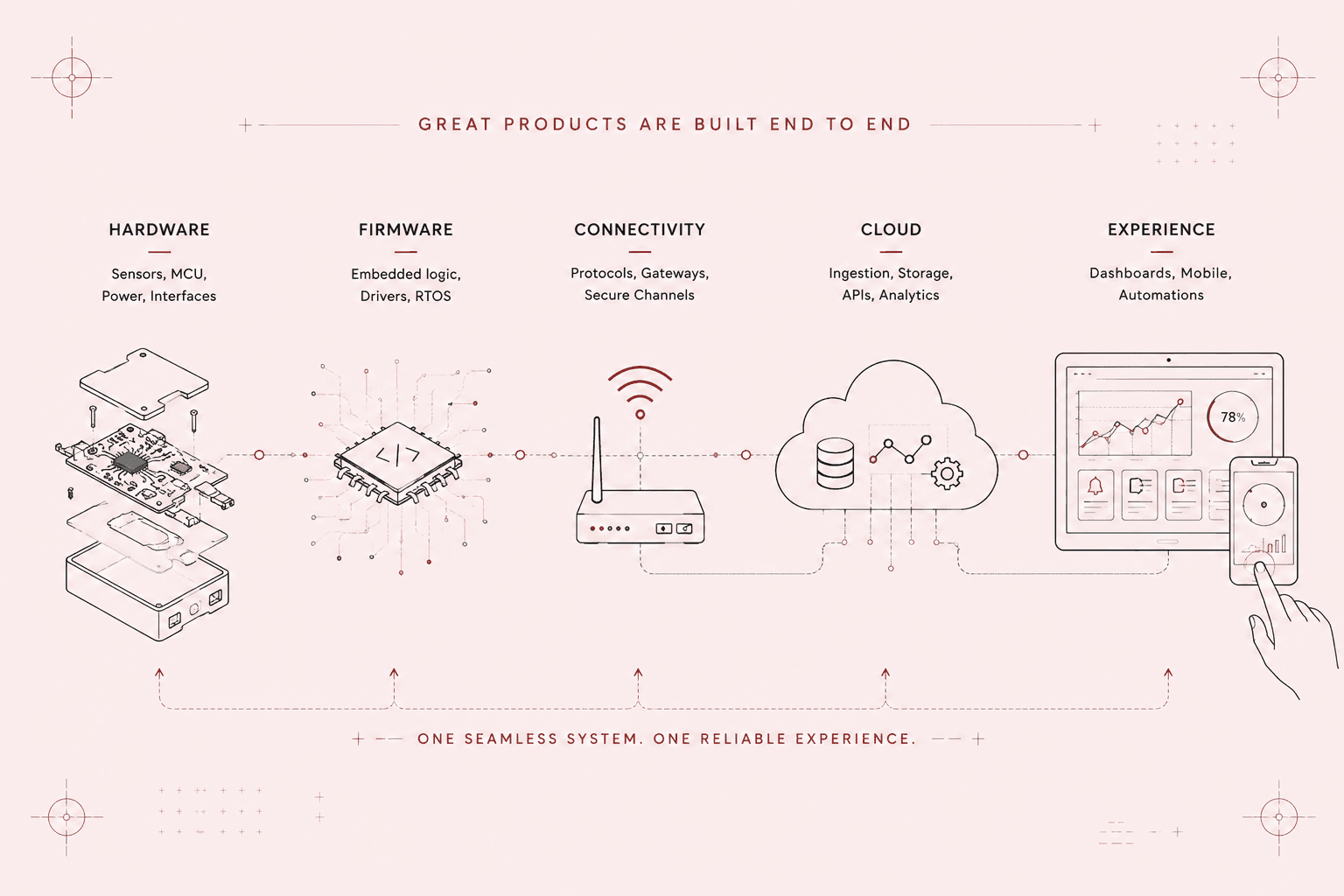
- A single system map reduces silent assumptions between hardware, firmware, and cloud teams.
Guiding Products Across Layer Boundaries
Dartwings begins boundary programs by mapping every handoff — power state, schema, retry policy, and security seam — before implementation starts. This makes invisible assumptions visible early, when architecture is still malleable.
We then validate each seam under realistic stress: reconnect storms, partial cloud outages, and mixed firmware versions. The goal is not documentation for its own sake — it is field reliability at the points where products usually fail.
From Challenge to Precision Outcome
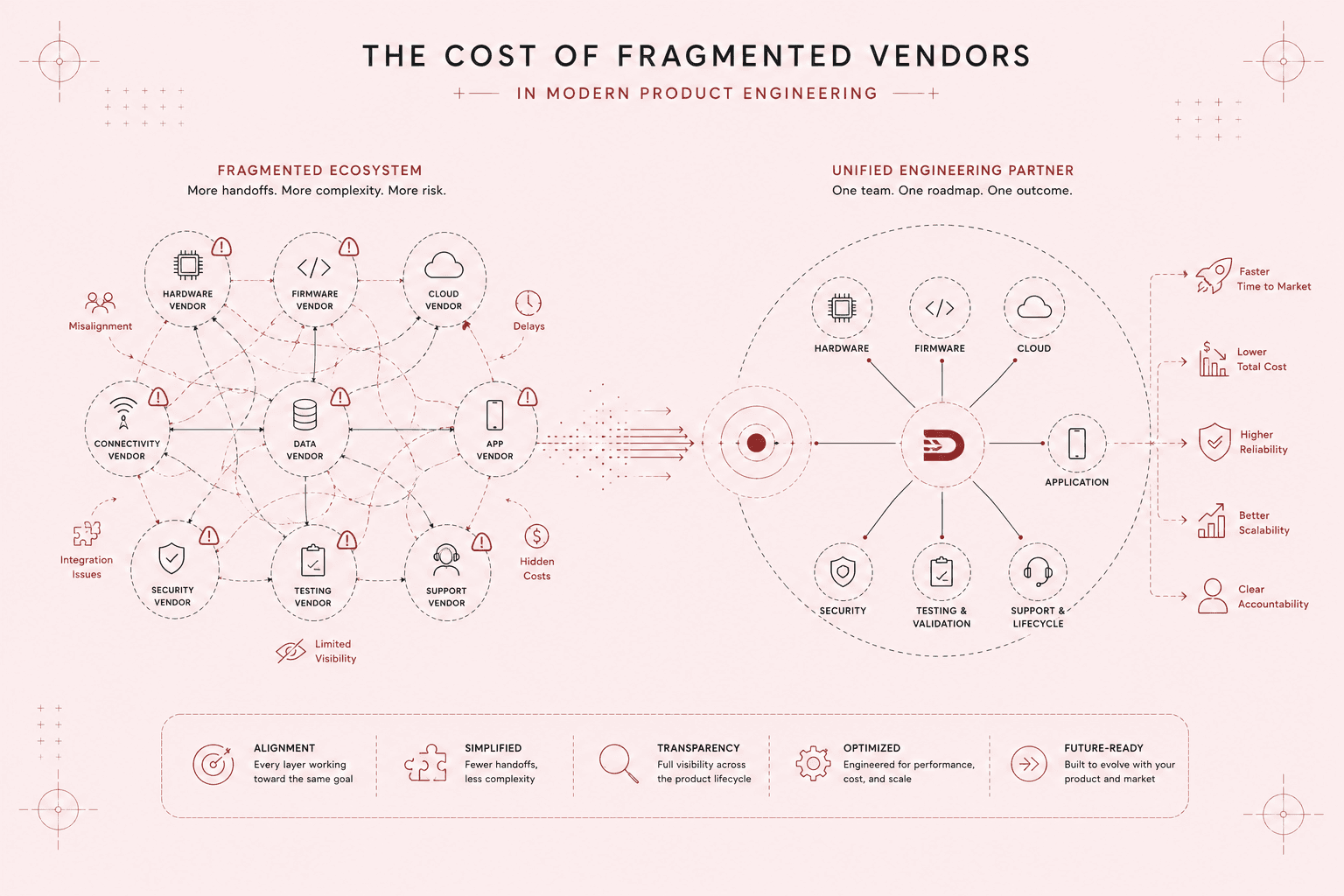
Dartwings is an Engineering Guidance Partner — not a software agency or IoT vendor. We guide disconnected technologies through architecture, execution, validation, and deployment until they become reliable, field-ready systems.
- SCOPEChallenge
- MAPArchitecture
- BUILDEngineering
- HARDENValidation
- LAUNCHDeployment
- LOCKPrecision Outcome
Continue Reading

Start Your Mission
Whether you have a defined technical spec or the seed of an idea, describe your engineering challenge and we will respond with a guided path to a validated outcome.